If a pest control company has quoted you for termite treatment and you want to know what will actually be pumped into your walls and floor, the short answer is this: most anti-termite work in Indian homes today uses imidacloprid, bifenthrin or fipronil, diluted in water and injected into drilled holes along the walls. Chlorpyrifos was the old workhorse and is still seen on some quotes, but its use has been under regulatory review for years, so ask before you agree to it.
This guide explains what each of these chemicals does, how they differ, which one suits which situation, and how to read the label on the bottle so you know the technician is using a registered product at the right strength. Nothing here is a brand recommendation. We name active ingredients only, because that is what matters.
What chemical is used for termite treatment in most Indian homes?
Termite chemicals fall into two broad groups. Repellents create a zone that termites detect and avoid. Non-repellents are invisible to termites, so the insects walk through the treated soil, pick up the chemical, and carry it back to the colony where it spreads through grooming and food sharing. That difference decides how the job works.
| Active ingredient | Common strength sold | Type | Where you usually see it |
|---|---|---|---|
| Imidacloprid | 30.5% SC | Non-repellent | Post-construction drilling, pre-construction soil |
| Bifenthrin | 2.5% EC | Repellent | Soil barriers, perimeter treatment, wood surfaces |
| Fipronil | 2.5% EC and other strengths | Non-repellent | Drilling and soil work where products are registered for it |
| Chlorpyrifos | 20% EC | Repellent and contact | Older quotes; check its current status before agreeing |
| Hexaflumuron and similar | Bait matrix | Growth regulator | Bait stations, not liquid spraying |
The percentages refer to the concentrate in the bottle, not what goes into your wall. A technician dilutes the concentrate with water according to the label. If you see a bottle of 30.5 percent imidacloprid, the working solution injected into the holes is a tiny fraction of that.
Imidacloprid: the most common choice now
Imidacloprid belongs to the neonicotinoid family. It affects the nervous system of insects and, at the low doses used against termites, it slows them down before it kills them. That delay is useful. A termite that dies instantly at the barrier tells the colony nothing. One that wanders back through the galleries carries the chemical to nest mates.
Most companies use it for drilling-and-injection jobs in flats and houses because it has low odour, mixes easily in water, and is widely available through licensed dealers. Its weakness is that it binds to soil and works best when the treated zone stays continuous. Gaps in the drilling pattern leave gaps in protection.
Bifenthrin: a barrier that termites avoid
Bifenthrin is a synthetic pyrethroid. Termites sense it and turn away, so it works by creating a line they will not cross. It is often used for pre-construction soil treatment, around the outside of independent houses, and on exposed wood surfaces. It has a longer track record in soil and holds up reasonably well in heavy clay.
The catch with a repellent barrier is simple. If the line has a break, for example where a plumber later cut through the floor, termites find the break and walk around the treated soil. Repellents protect the building but do little to reduce the colony itself.
Fipronil and the question of chlorpyrifos
Fipronil is another non-repellent that some operators prefer for heavy infestations because it is active at very low concentrations. Several formulations are registered in India for termite use, but not every fipronil product on a shop shelf is approved for buildings. Some are meant only for crops. The label tells you which.
Chlorpyrifos is the chemical your parents' generation knew. It has a strong smell, lingers in closed rooms, and has faced restrictions in many countries over health concerns. In India its use has been reviewed more than once, and the rules for household and building use can change. If a quote names chlorpyrifos, ask the company to show you the current label and registration, and feel free to ask for an imidacloprid or bifenthrin alternative instead. Lindane, which older building specifications mention, should not be used at all.
How to read the label before the technician starts
Every insecticide sold legally in India must be registered with the Central Insecticides Board and Registration Committee, usually shortened to CIB&RC, under the Insecticides Act. You do not need to understand chemistry to check a few things on the bottle.
- Registration number. Look for a CIR or registration number printed on the label. A bottle without one, or a plain unlabelled can, is a warning sign.
- Crop or public health use. The label lists what the product is approved for. You want wording that covers termites in buildings or soil, not just paddy or cotton.
- Toxicity triangle. Indian labels carry a coloured diamond or triangle mark: red for the most toxic class, then yellow, blue and green. Most building termiticides sit in the middle bands.
- Dilution rate. The label states how much concentrate goes into how much water. Ask the technician how much they are mixing. Under-dilution is the most common corner cut.
- Manufacturing and expiry date. Old stock loses strength. Anything well past its date should not be used.
Taking a photo of the label is a reasonable request. Good technicians are used to it. If someone refuses to show you what they are using, you have learned something important about the company. Our guide on choosing a reliable pest control company lists other questions worth asking.
Which chemical suits which situation
There is no single best termiticide. The right choice depends on what you are treating and how bad it is.
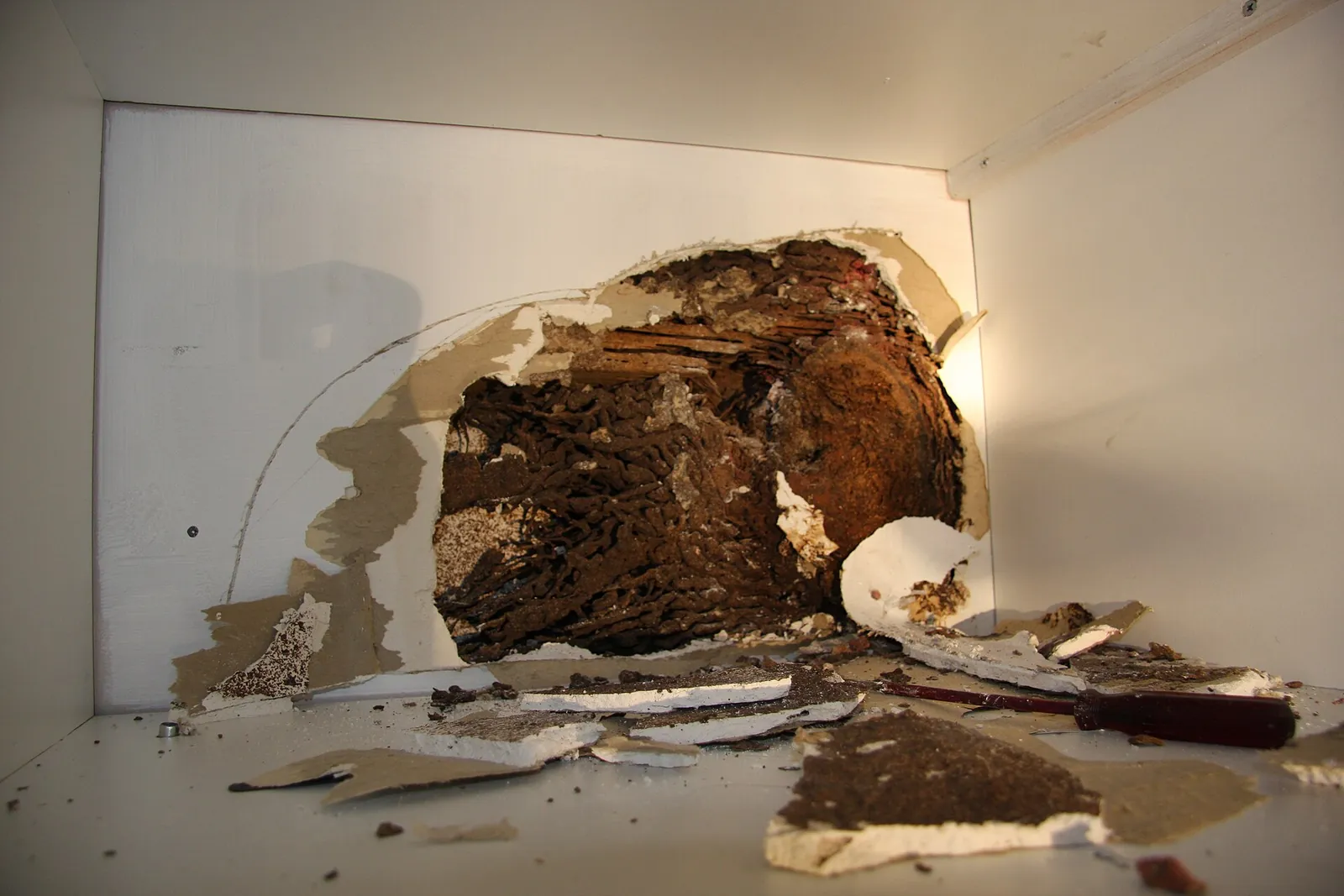
- Flat with active mud tubes on walls: a non-repellent such as imidacloprid injected along the skirting is usually the first choice, because it can reach the colony.
- New construction: soil treatment at the plinth stage often uses bifenthrin or imidacloprid. Our article on pre-construction versus post-construction treatment explains the timing.
- Independent house with garden and borewell: baiting may be better than heavy liquid treatment near the water source.
- Furniture with drywood termites: liquid soil chemicals do nothing here. Wood injection or local treatment of the piece is what works.
If you are weighing liquid treatment against stations, the comparison in chemical versus baiting termite treatment goes into more depth.
What the chemical choice will not fix
A stronger chemical does not compensate for poor workmanship. Most failed termite jobs we see were done with a perfectly good product, but the holes were spaced too far apart, too little solution went into each one, or the technician skipped the bathroom and kitchen because tiles were in the way. A barrier with a gap is a barrier that fails.
Chemicals also do not fix damp. A leaking pipe inside a wall keeps the soil and masonry moist, and termites will keep returning to that spot. Repairing the leak is part of the treatment. Treatment cost is covered in detail in our termite treatment cost breakdown, and typical whole-home drilling for a 2BHK runs roughly ₹6,000 to ₹13,000, though these are typical ranges and not quotes.
Safety at home during and after treatment
Ask the company to keep children and pets out of the treated rooms until the floor is dry and the holes are sealed, usually a few hours. Keep windows open. Move food, utensils and toothbrushes out of the kitchen and bathroom before drilling starts. If anyone at home has asthma or is pregnant, tell the company in advance so they can plan the job around that person being away for the day.