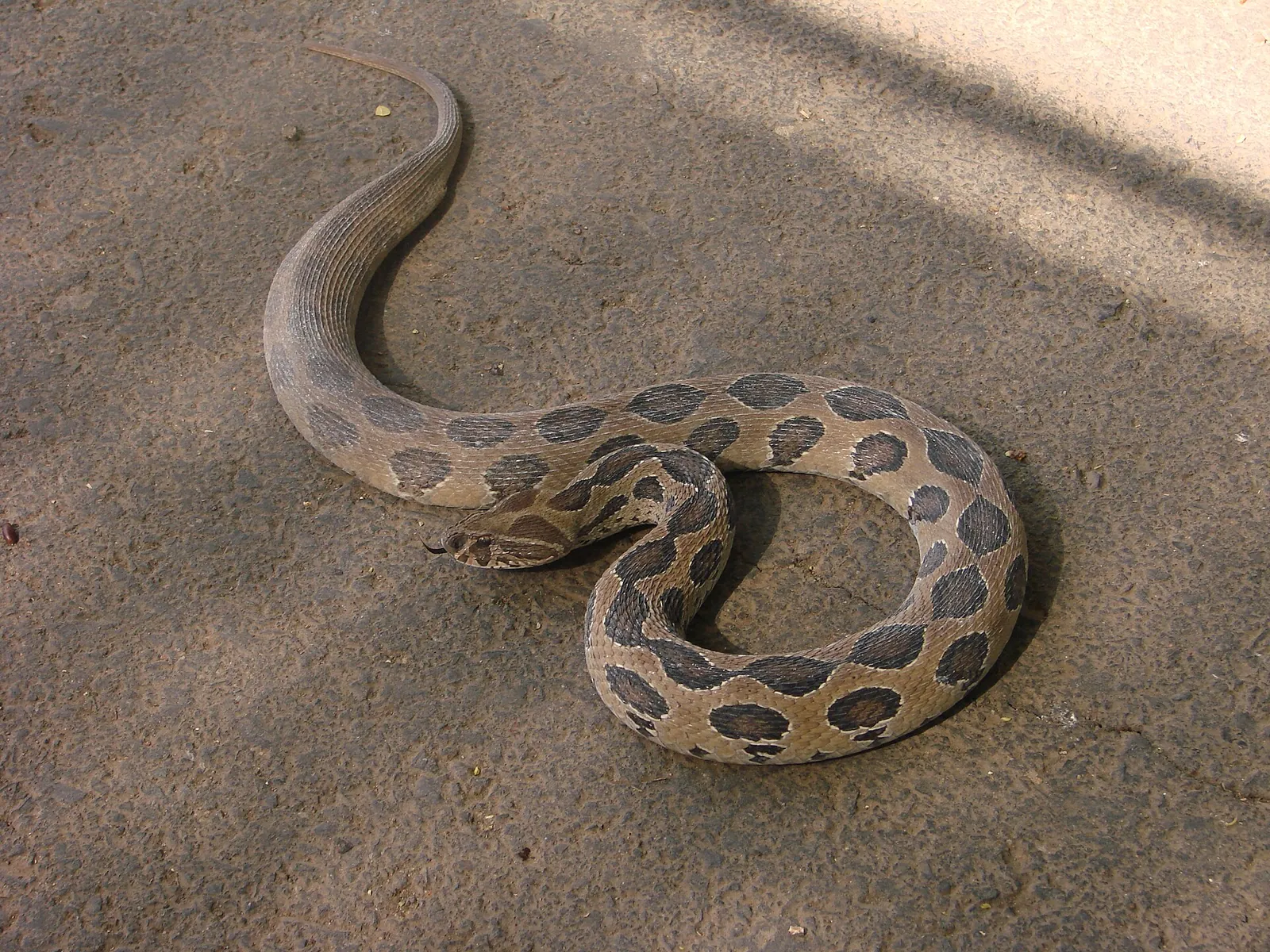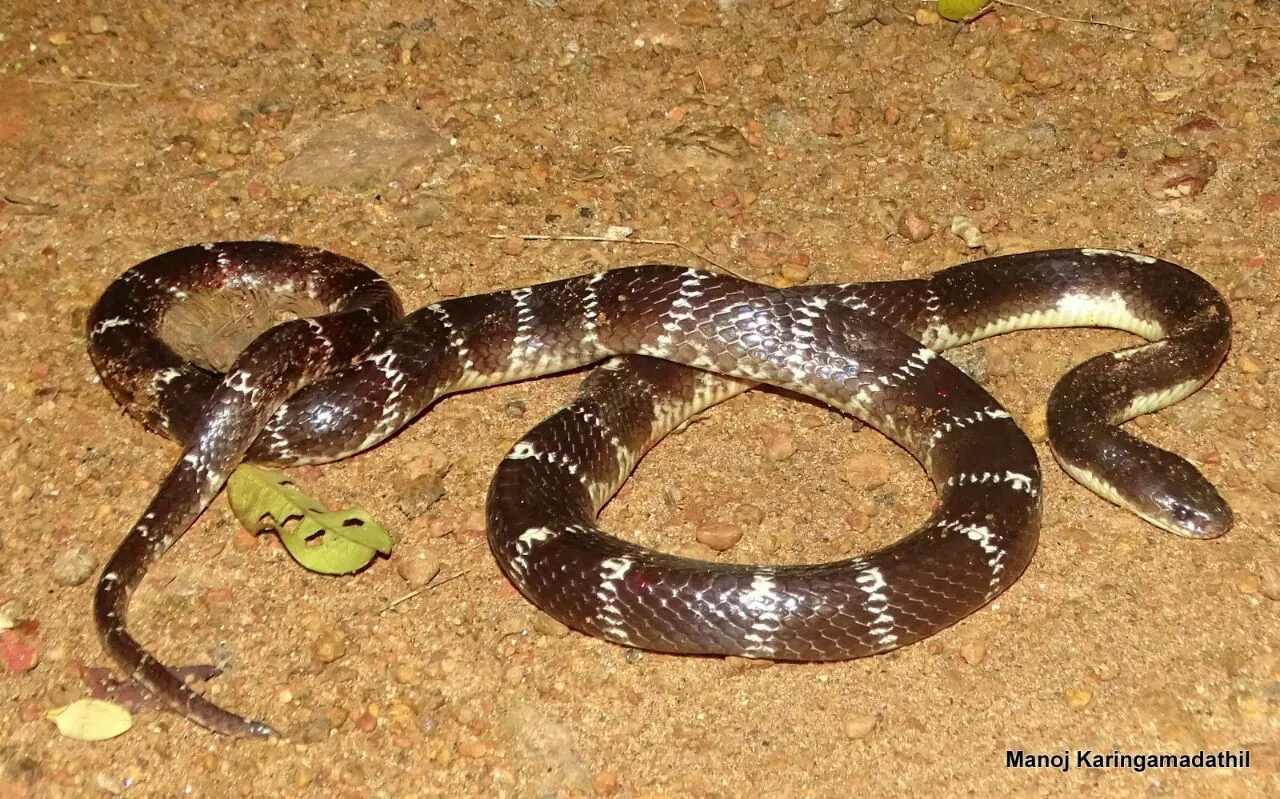
The common krait is a slim, glossy black or steel-blue snake with thin white bands across its back, and it is one of the few Indian snakes that regularly slips into houses at night. To keep a common krait away from home, you remove what draws it in (rats, frogs, cluttered corners), close the gaps it uses to enter, and, most importantly, stop sleeping on the floor in areas where kraits live. That last habit matters more than any spray or powder sold for snakes.
This guide is written for families in villages, farmhouses, ground-floor homes and the edges of towns, where krait bites mostly happen. It covers how to recognise the snake, why its bite is so often missed, and what to do in the first hour if you suspect one.
How to recognise a common krait
The scientific name is Bungarus caeruleus. Adults are usually around a metre long, though some grow longer. The body is smooth and shiny, almost like polished metal under a torch. The white crossbands are narrow and often arranged in pairs, and they tend to be faint or missing near the neck and become clearer towards the tail. The head is not much wider than the neck, and the eyes are small and dark.
Look closely along the middle of the back and you will see a row of slightly larger, six-sided scales running like a ridge from neck to tail. Rescuers use this row to separate a krait from its look-alikes, but you should only ever check it in a photo, never by getting close.
| Feature | Common krait | Common wolf snake (harmless look-alike) |
|---|---|---|
| Colour | Glossy black or bluish-black | Brown to dark brown, less shiny |
| Bands | Thin white bands, clearer towards the tail | White bands mostly on the front half |
| Head | Rounded, barely wider than neck | Flat, slightly wider, with a white collar in many |
| Back scales | Row of enlarged six-sided scales along the spine | No enlarged row |
| Behaviour | Calm and slow by day, active at night | Climbs walls and grills readily, bites when held |
If you cannot tell which one you are looking at, treat it as a krait. Getting that wrong in the cautious direction costs you nothing.
Why kraits come indoors at night
Kraits hunt after dark, and they eat other snakes, lizards, frogs and rodents. A house with rats in the store room, toads near the bathroom drain and geckos on the walls is a full menu. During the monsoon, flooded burrows push them out of the ground, and the dry floor of a house becomes attractive shelter. In the hot months before the rains, they also move around more as they search for cooler hiding places.
They usually enter through the gap under a door, an open drain outlet, a broken ventilator, a hole where a pipe enters the wall, or simply an open door left that way for air. Inside, they look for dark spots: under beds, inside stacked bedding, behind grain sacks, among shoes, or in a pile of firewood kept indoors.
The sleeping-on-the-floor risk
Many krait bites in India happen between midnight and dawn to people sleeping on a mat on the floor. The snake is not hunting the person. It is moving through the room, and a sleeper rolls onto it or puts a hand on it, and it bites in defence. Children and elderly relatives who sleep on the floor in summer are especially exposed.
- Sleep on a cot or bed raised off the ground, and keep the bed away from the wall so a snake cannot reach it easily.
- Use a mosquito net and tuck its edges firmly under the mattress all round. A tucked net is a simple physical barrier that also stops mosquitoes.
- Shake out bedding, mats and pillows before lying down, and do not leave blankets trailing to the floor.
- Carry a torch when you get up at night, even for a short walk to the bathroom or the courtyard.
- Wear closed footwear outdoors after dark, and never put a bare hand into a dark corner, shoe or sack.
Why a krait bite is so easy to miss
This is the most important part of this article. A krait bite often causes little or no pain, and the fang marks can be tiny or impossible to find. There may be no swelling at all. People wake up with what feels like an ant bite or nothing, and go back to sleep.
The venom acts on the nerves, and symptoms can take several hours to appear. Common early signs include stomach pain, vomiting, drooping eyelids, double or blurred vision, difficulty swallowing or speaking, and weakness in the limbs. Breathing can fail later as the muscles weaken. Some people are found in the morning unable to open their eyes properly or to stand.
So the rule is simple: if anyone wakes at night with unexplained stomach pain, heavy eyelids or a strange weakness, and you live where kraits are found, treat it as a possible snakebite and go to a hospital immediately. Do not wait for proof. Do not wait to see whether it gets worse.
What to do if you suspect a krait bite
- Keep the person calm and as still as possible. Panic and movement do not help.
- Remove rings, bangles, anklets and tight clothing near the bite before any swelling begins.
- Keep the bitten limb still, loosely supported with a splint or a folded cloth, roughly at the level of the body.
- Call 108 or your local ambulance number, or go straight to the nearest government hospital or community health centre that can give anti-snake venom.
- Tell the doctor the time of the bite, or the time symptoms started, and any changes you have noticed on the way.
Do not tie a tight band or tourniquet, do not cut the skin, do not try to suck out venom, and do not go to a local healer first. Each of these wastes time or causes harm. Anti-snake venom made in India covers the krait, and hospitals can also support breathing if needed. Since kraits move most in the wet months, it also helps to read our guide to monsoon snake safety at home.
Keeping kraits out of your home
Nothing you spray will make a house snake-proof. What works is making the house less inviting and harder to enter.
- Fit a door sweep or rubber strip so the gap under each outer door is less than about half a centimetre.
- Cover drain outlets and bathroom water exits with fine steel mesh, and repair broken ventilator jalis.
- Seal holes where water pipes, gas pipes and cables enter the wall.
- Control rats properly, because a house full of rodents will keep attracting snakes no matter what else you do. Our guide on getting rid of rats and mice safely explains how.
- Keep firewood, bricks, coconut husks and old furniture away from the walls and off the ground.
- Cut grass short close to the house, and keep a clear, open strip around the walls.
Phenyl, kerosene, carbolic powder and garlic are widely tried. None of them reliably repels snakes, and some of them are toxic to children and pets. Spend that effort on gaps and rats instead.
If you find a krait in the house
Do not try to kill it. Snakes in India are protected under the Wildlife (Protection) Act, 1972, and most bites happen when people try to beat, catch or chase them. Move everyone out of the room, close the door, and keep an eye on where the snake goes from a safe distance. Call a trained snake rescuer or your local forest department office. Many districts now have volunteer rescuers who will come at night.