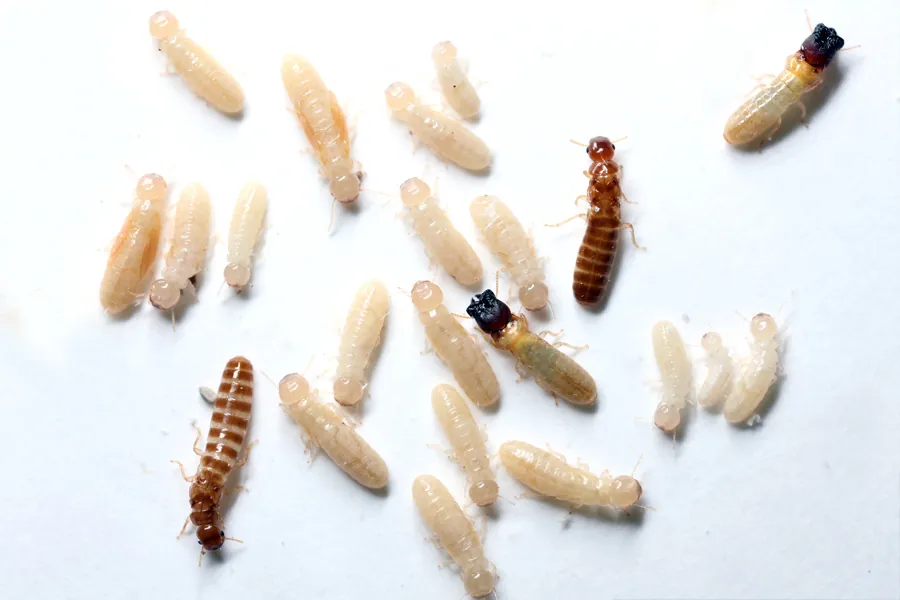
If you keep sweeping up small heaps of what looks like sand or poppy seeds under a cupboard, a bed or a wooden sofa, you are almost certainly dealing with drywood termites. Treatment for a single piece of furniture usually costs ₹800 to ₹3,000 in 2026 and involves drilling small holes and injecting a termiticide into the galleries inside the wood. Unlike the common soil termites, drywood termites need no contact with the ground, so treating the floor will not help them at all.
This guide covers how to confirm drywood termites, what treatment options exist in India, what each one costs, and when a piece is too far gone to save.
What drywood termites are and why they choose furniture
Drywood termites, mostly species of the genus Cryptotermes in Indian homes, live entirely inside a piece of dry wood. A pair of swarmers flies in, often on a warm evening, finds a crack or joint in a wooden item, seals itself in and starts a colony. The colony stays small, often a few hundred to a few thousand insects, and may take years to cause visible damage.
They are found more in coastal and humid regions such as Mumbai, Goa, Kerala, Chennai and Kolkata, but they turn up across the country, especially in old furniture, antique pieces bought second-hand and wooden items brought from another house. Our guide to drywood versus subterranean termites explains the full set of differences.
Pellets: the sign that confirms them
Drywood termites keep their galleries clean by pushing droppings out through tiny kick-out holes. The droppings are hard, dry pellets about one millimetre long with six flat sides, usually beige to dark brown depending on the wood. They pile up in small cones on the floor or shelf below the hole. If you rub a few between your fingers they feel gritty, not powdery.
- Pellets with six sides: drywood termites.
- Fine flour-like powder with round holes: powder post beetles, a different pest.
- Coarse sawdust with insect bits: carpenter ants.
- Mud on the surface: subterranean termites coming from the soil.
To check whether the colony is still active, sweep the pellets away completely and look again after a week. Fresh heaps mean live termites.
Drywood termite treatment options and cost
| Method | How it works | Typical cost | Best for |
|---|---|---|---|
| Drill and inject | Small holes drilled into galleries; liquid or foam termiticide injected; holes filled | ₹800 to ₹3,000 per item | Most furniture with local damage |
| Surface treatment after repair | Wood treatment brushed or sprayed on all faces, then polish | Often added to the injection price, or ₹300 to ₹1,500 per fixture | Preventing reinfestation |
| Replacing damaged parts | Carpenter cuts out and replaces hollow sections | Depends on carpentry | Legs, rails, panels that are badly eaten |
| Whole-house fumigation | Building sealed and gassed by licensed fumigators | Rarely offered for Indian homes | Not practical for most flats |
These are typical ranges, not quotes, and metros sit at the top. A home with several affected pieces is usually quoted per item or as a package. Our termite price guide puts these numbers alongside whole-home rates.
How a drill-and-inject job is done
- The technician taps the piece to map hollow sections and marks the kick-out holes.
- Holes of about 3 to 5 millimetres are drilled into the galleries, usually 15 to 30 centimetres apart along affected parts.
- A termiticide, often as a liquid or expanding foam, is injected until it reaches the galleries.
- Holes are plugged with wood filler, wax or a matching putty.
- All exposed faces, including the back and underside, are treated to discourage new swarmers.
- You are asked to sweep away pellets and watch for new heaps over the next four to six weeks.
The piece can usually be used again the next day once the smell has cleared. Keep it in a ventilated room for 24 hours, and keep children and pets away from it during that time.
A note on fumigation
In some countries, whole houses are tented and gassed for drywood termites. In India this is rare for homes. The fumigants involved are highly dangerous, and aluminium phosphide in particular may only be used by licensed fumigation operators under strict conditions. It must never be used in an occupied home or by a homeowner. If anyone offers to put tablets inside your cupboard and close it, refuse.
For small loose items such as a wooden box or carving, some people freeze them in a sealed bag in a deep freezer for one to two weeks. This can kill the insects in small pieces, but results vary and it is not suitable for furniture.
Checking second-hand and antique pieces before you buy
A large share of drywood problems in Indian homes arrive inside furniture someone bought from an old house, a dealer or an online resale listing. Before paying, turn the piece over in good daylight and look at the underside, the inside of drawers and the joints where legs meet the frame. Pinholes, small heaps of grains in drawer corners and patches that sound hollow when tapped are reasons to walk away or to negotiate a price that covers treatment. Ask the seller when it was last polished, because fresh polish can hide kick-out holes. If you still want the piece, keep it in a balcony or garage for a few weeks and watch for pellets before bringing it near your other furniture. Having it treated before it enters the home is far cheaper than treating three pieces later.
When to repair and when to replace
If the damage is limited to one leg, rail or panel and the frame is still solid when you push on it, injection and a carpentry repair are worthwhile, particularly for solid wood or sentimental pieces. If the piece is cheap board furniture, sags under weight, or the screwdriver sinks in along most of its length, replacing it is usually cheaper and safer. Move a badly infested piece out of the house quickly, because swarmers from it can start colonies in other furniture.
What treatment will not fix
Treating one piece does not protect the next. Drywood colonies can exist in several items, and some may not show pellets yet. Ask the technician to check every wooden item in the room. And if the termites are in built-in woodwork such as door frames or a wooden ceiling, the job is bigger. Also check that what you have really is drywood termites. Carpenter ants and wood-boring beetles look similar at first glance, and our article on wood-damaging insects helps you tell them apart.