Termite damage is the most expensive pest problem most Indian homeowners will face, and it is also one of the most preventable. Treatment after an infestation can cost tens of thousands of rupees once door frames, wardrobes and kitchen cabinets are involved. Prevention costs much less, but it only works if it starts before the damage, which is exactly when people least expect to need it.
This guide is about prevention in an existing home: the habits, maintenance and early checks that keep termites out, and how to know when prevention is no longer enough.
Understand how termites reach your home
Most termite damage in India is caused by subterranean termites, such as species of Odontotermes, Coptotermes and Microtermes. They live in large colonies in the soil and need moisture to survive. They reach wood inside your home by travelling through the soil, then through cracks in the floor slab, gaps around pipes, expansion joints, electrical conduits and hollow blocks. When they have to cross an exposed surface, they build mud tubes to stay protected from dry air.
A second type, drywood termites, lives entirely inside dry wood without soil contact. They are less common but cause damage in furniture and wooden ceilings, particularly in coastal areas. They leave small pellets that look like coarse sand, not mud tubes.
Because subterranean termites depend on soil and moisture, prevention focuses on three things: keeping wood away from soil and damp, blocking entry routes, and catching activity early.
Control moisture first
Termites are drawn to damp walls and wet wood far more than dry ones. Most serious infestations in flats start in the kitchen and bathrooms, where leaks and seepage keep walls and the wood near them wet.
- Fix leaking pipes, taps and toilet cisterns promptly, especially inside walls behind wardrobes and kitchen units.
- Repair roof and terrace seepage before the monsoon, and check walls for damp patches after heavy rain.
- Make sure AC drain pipes discharge away from walls and do not drip onto wooden window frames.
- Keep bathroom and kitchen exhaust fans working so humidity does not build up.
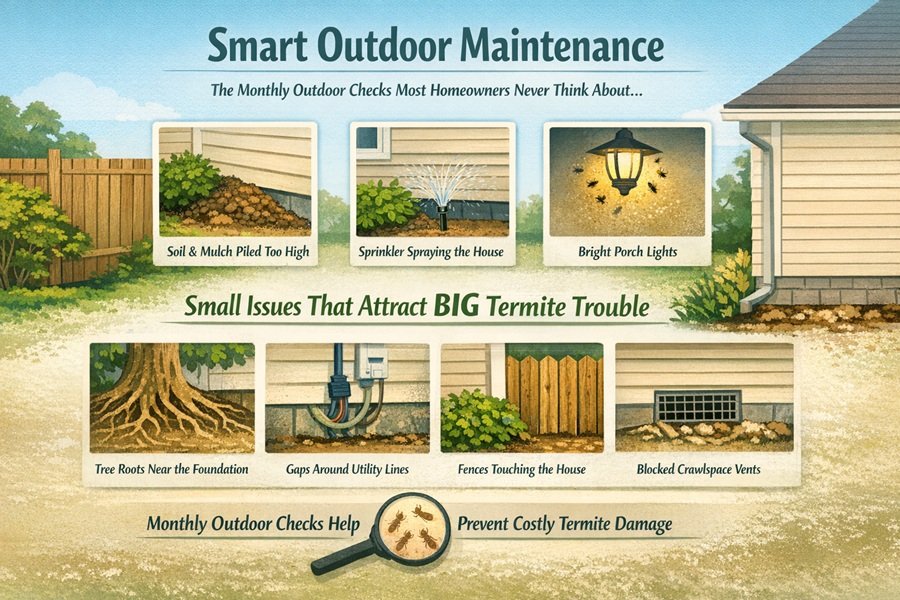
- In independent houses, ensure rainwater drains away from the foundation and garden beds are not watered against the wall.
Keep wood and cellulose away from soil and damp walls
Anything made of wood, paper or cardboard that touches soil or a damp wall is an invitation. In independent houses this includes wooden posts in the garden, firewood stacked against the house and wooden steps resting on soil. Inside flats it includes cardboard cartons stored on the floor of lofts and store rooms, piles of newspapers and books against walls, and wooden furniture pushed tight against external walls.
- Leave a gap of at least 2 to 5 cm between wardrobes, beds and the wall, especially on external and bathroom walls.
- Store cartons, books and papers on plastic or metal racks off the floor.
- Choose plastic or metal storage boxes over cardboard for lofts.
- Use treated or termite-resistant wood, or engineered boards with resistant treatment, when renovating.
- Keep firewood, timber and garden waste off the ground and away from house walls.
Block the routes in
Seal visible cracks in floors and at the junction of the floor and walls, especially in ground-floor and lower-floor homes. Fill gaps around pipes and conduits where they pass through the floor or walls. These are the same routes cockroaches use, so the effort pays off twice. Where the wooden door frame meets the floor, a frame that sits directly on the floor rather than on a small concrete or stone base is more vulnerable; a raised base or a protective coating at the bottom helps.
Check for early signs every few months
| Sign | Where to look | What it means |
|---|---|---|
| Pencil-thin mud tubes | Walls behind furniture, skirting, inside cupboards | Active subterranean termites |
| Winged insects or shed wings | Near windows and lights after rain | A nearby colony is swarming |
| Hollow-sounding wood | Door frames, skirting, cabinet bases | Wood eaten from inside |
| Bubbling or cracked paint | Walls and wooden surfaces | Moisture and possible termite tunnels behind |
| Sand-like pellets | Below wooden furniture or ceilings | Drywood termites |
| Mud lines on books or papers | Lower shelves of bookcases | Termites feeding on paper |
Tap door frames and skirting with the handle of a screwdriver every three months. Healthy wood sounds solid; hollow wood sounds papery. Pull out wardrobes and look behind them twice a year, ideally before and after the monsoon.
When preventive treatment makes sense
For many homes, good habits and regular checks are enough. Preventive chemical treatment makes sense if termites are known in your building or neighbourhood, if the home has a lot of wooden fittings, if it is on the ground or first floor, or if the building is older than about ten years without documented treatment. An inspection from a pest control company, often free or low-cost, can tell you whether there is activity nearby.
Preventive options include a post-construction soil treatment along the wall-floor junction, treatment of wooden fittings with a termiticide, and termite bait or monitoring stations around independent houses. A professional annual termite inspection, often bundled into a maintenance contract, catches problems early.
Mistakes that let termites in
- Scraping away mud tubes and spraying household insecticide; this disturbs the termites and they simply move elsewhere.
- Painting over damp walls instead of fixing the source of moisture.
- Installing new modular furniture against a wall that already shows mud lines without treatment.
- Renovating floors or adding rooms without re-checking the termite barrier.
- Assuming a concrete flat cannot get termites.
Buying furniture without bringing termites home
New and second-hand furniture is a route in that prevention plans often forget. Before buying old wooden furniture, check the underside and the backs of drawers for small holes, powder and sand-like pellets. For new solid-wood pieces, ask whether the timber was seasoned and treated against borers and termites. Keep new pieces off damp floors for the first few weeks so you can spot any problem before it spreads.
What prevention costs compared to repair
A preventive termite treatment for a typical 2BHK flat costs roughly ₹6,000 to ₹15,000 in 2026, often with a warranty of one to five years. Replacing a single damaged wardrobe can cost more than that, and a home with damaged door frames, kitchen cabinets and wooden flooring can face repair bills of ₹50,000 or more. Even a yearly inspection fee is small compared with one damaged fitting.