People often ask us about the Indian house cockroach, as if there were a single kind. There is not. Cockroaches are very common in India, in almost every city and climate, but the ones in your home are usually one of five species, and the kind you see changes the treatment completely. The big reddish one in the bathroom at night is an American cockroach coming up from the drains. The small striped one in the kitchen cabinet is a German cockroach, which breeds inside your home. Knowing which one you have is the difference between a fix that works and months of wasted spray.
Are cockroaches common in India, and why?
Yes. India's warm temperatures, long monsoon humidity, dense housing and shared drainage suit cockroaches very well. They need warmth, moisture, food and tight places to hide, and most Indian kitchens and bathrooms provide all four. Older buildings with open drains and shared plumbing shafts tend to have more of the large drain species. Newer flats with modular kitchens, lots of appliances and packaged groceries tend to have more of the small kitchen species.
The five species you are most likely to see
| Species | Size | How to recognise it | Where it lives |
|---|---|---|---|
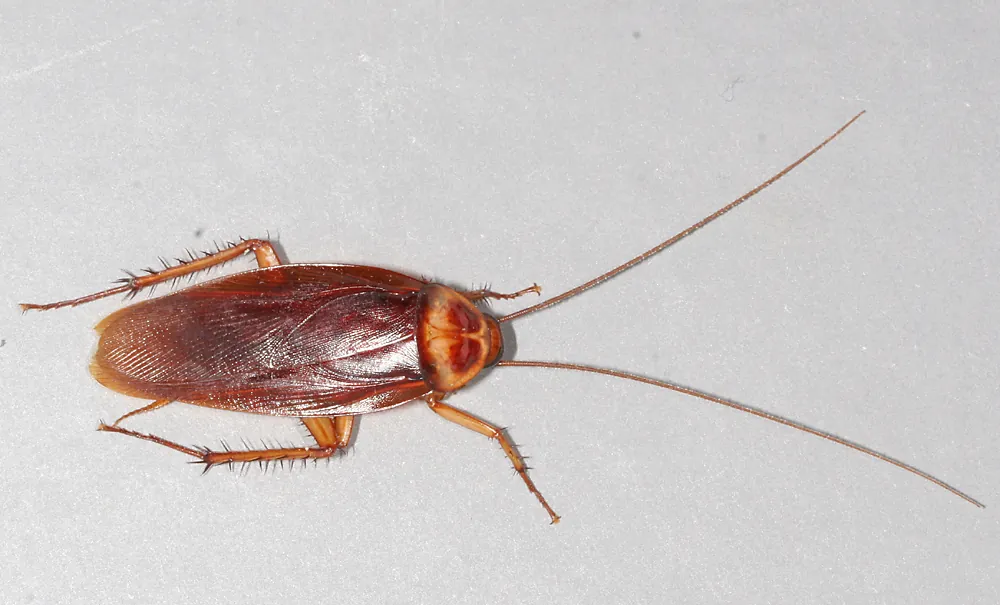
| American cockroach (Periplaneta americana) | About 3.5-4.5 cm | Large, reddish-brown, pale yellowish band around the shield behind the head; flies short distances in warm weather | Drains, sewers, floor traps, manholes, basements, bathrooms |
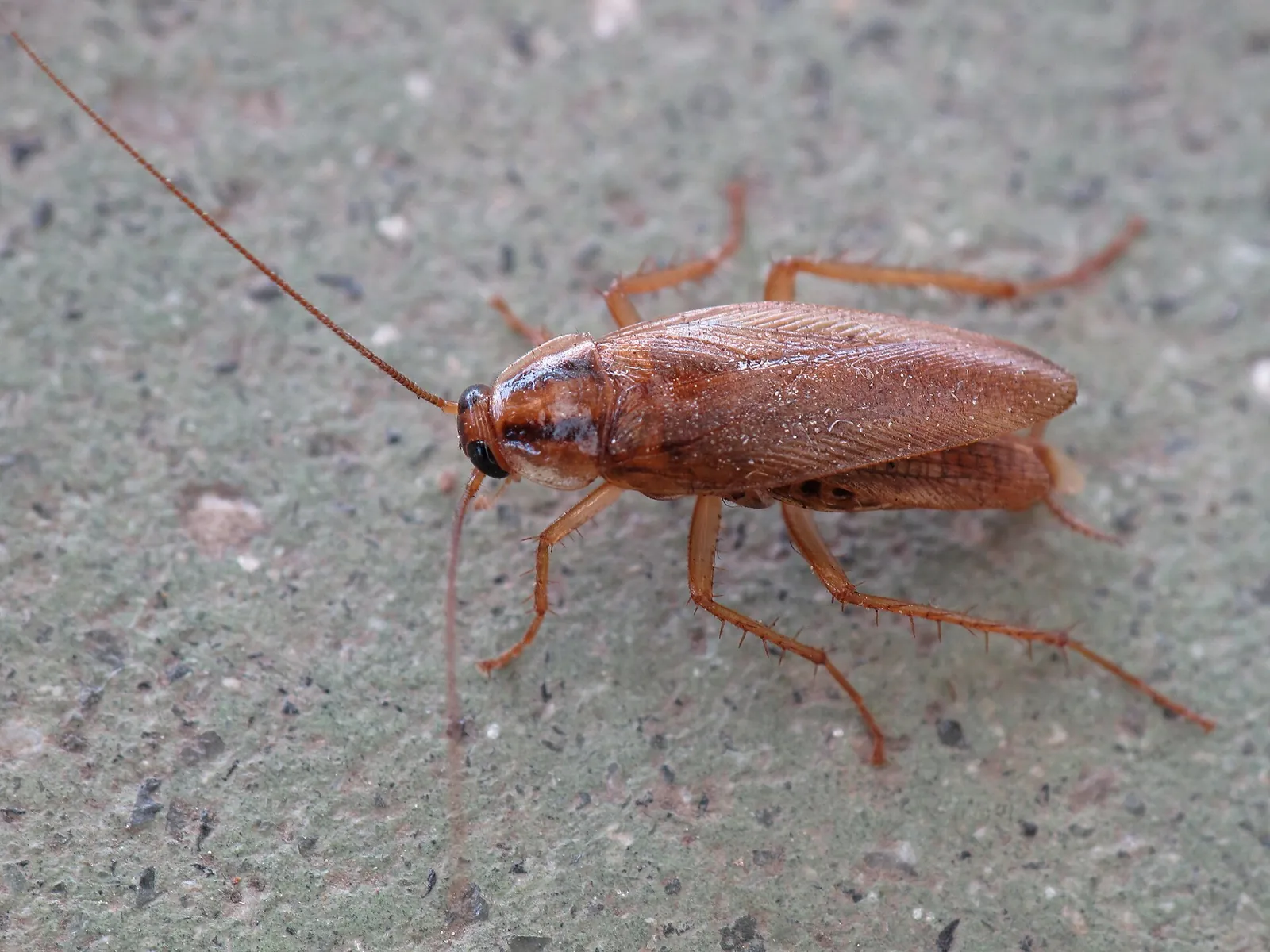
| German cockroach (Blattella germanica) | About 1.2-1.6 cm | Small, light tan, two dark parallel stripes on the shield behind the head | Kitchen cabinets, hinges, fridge and microwave, sink area |
| Brown-banded cockroach (Supella longipalpa) | About 1-1.5 cm | Small, with two lighter bands across the wings and body | Drier, higher spots: furniture, behind frames, electronics, bedrooms |
| Oriental cockroach (Blatta orientalis) | About 2-2.5 cm | Very dark brown to black and glossy; females have tiny wing stubs | Cool damp areas: drains, basements, under floors. Less common in most Indian homes |
| Surinam cockroach (Pycnoscelus surinamensis) | About 1.8-2.5 cm | Dark glossy brown body with paler wings; burrows into soil | Plant pots, gardens, balcony planters, compost |
You may also see the Australian cockroach, a close relative of the American cockroach with a bright yellow margin on its shield and yellow streaks on its wings, mostly in gardens and around houses with plants.
American cockroach: the drain visitor
This is the cockroach most Indians picture. It lives in sewer lines, drainage chambers and the space under floor traps, and comes up into bathrooms and kitchens at night, especially after rain. It lays a dark, bean-shaped egg case holding around 14 to 16 eggs and glues it in a sheltered crack. Numbers jump during the monsoon, as explained in our article on why cockroaches increase during monsoon.
What it means for you: the problem is often outside your flat. The fixes are a self-closing floor trap in every drain, sealing gaps where pipes pass through walls and floors, and building-level treatment of drainage chambers. Gel inside the kitchen helps, but will not stop new ones climbing up the pipe.
German cockroach: the one that breeds in your kitchen
The German cockroach is the one to worry about most, because it lives and multiplies entirely indoors. A female carries her egg case, which holds roughly 30 to 40 eggs, attached to her body until it is nearly ready to hatch, so the eggs are protected from most sprays. In warm conditions the young can become adults in a couple of months, so numbers rise very quickly.
It usually arrives in cardboard grocery cartons, second-hand appliances, or furniture from an infested home. If you see small cockroaches in daylight or inside the microwave and fridge seals, the population is large. Spraying makes it worse by scattering them; gel bait in many small dots is the right tool.
Brown-banded, Oriental and Surinam cockroaches
The brown-banded cockroach looks like a German cockroach at first glance, but it prefers drier and warmer spots higher up in the home, such as behind photo frames, inside wardrobes, in TV units and inside electronic devices. It is often missed because people only check the kitchen. Treatment needs bait placed in bedrooms and living rooms too.
The Oriental cockroach is dark, slow and fond of cool damp places. It is not the main species in most Indian homes, but it can turn up around drains and basements. The Surinam cockroach is unusual because it burrows in soil. If you see dark cockroaches running out when you water a plant pot, this is likely the one. Its females can produce young without mating, so one insect in a nursery plant can start a population on your balcony. Repotting with fresh soil usually solves it.
Clues you can use without catching one
You do not always get a clear look at the insect, but the evidence it leaves helps. Droppings like ground black pepper in hinges and drawer corners point to German cockroaches. Larger droppings with ridges along their length, found near the bathroom floor trap or under the sink, fit the American cockroach. Empty egg cases are another clue: a dark, bean-shaped case stuck in a crack near a drain suggests American; a smaller, lighter case loose in a kitchen drawer suggests German. Sightings in a bedroom wardrobe or behind the TV, far from any water, point you towards the brown-banded cockroach.
Time of day matters too. Any cockroach seen in daylight, whatever the species, means the hiding places are full and some are being pushed out to feed.
Why identification changes the treatment
| If you have | Main approach | What to avoid |
|---|---|---|
| American cockroach | Seal drains and pipe gaps, self-closing floor traps, treat drainage chambers | Relying only on kitchen gel |
| German cockroach | Many small gel bait dots, repeat after 2-3 weeks, clean grease | Spraying, which scatters them and spoils bait |
| Brown-banded | Bait in bedrooms, wardrobes, behind frames and furniture | Treating only the kitchen |
| Surinam | Replace or treat potting soil, clear balcony leaf litter | Spraying indoors |
For a full home approach, see how to get rid of cockroaches in an Indian home.
When to call a professional, and what it costs
You can handle an occasional American cockroach with floor traps and sealing, and a small German cockroach problem with careful gel baiting. Call a professional if you see cockroaches in daylight, find many tiny nymphs, notice a musty smell in cabinets, or still see them after a month of correct baiting. A general cockroach and ant treatment for a 2BHK typically costs ₹1,200 to ₹2,500 in 2026, as a typical range rather than a quote. In a building where every flat shares the same shaft, ask the society about treating all flats together, because one treated flat surrounded by untreated ones rarely stays clear.
What a professional visit will not fix: an open floor trap, a leaking pipe that keeps the cabinet damp, or grocery cartons stored for weeks under the sink. Those are yours to sort out.