You switch on the kitchen light at eleven at night and half a dozen small tan insects scatter under the toaster. They are barely a centimetre long, fast, and they always seem to be near warmth — the fridge motor, the microwave vent, the gap behind the water purifier. That is Blattella germanica, the German cockroach, and it is the single hardest domestic pest to remove in an Indian flat.
This species is not the big reddish roach that walks up from your bathroom drain. It is a different animal with a different origin, a different breeding rate and a completely different treatment. Getting the two confused is why so many kitchens are sprayed month after month with nothing to show for it.
How to be sure it is a German cockroach
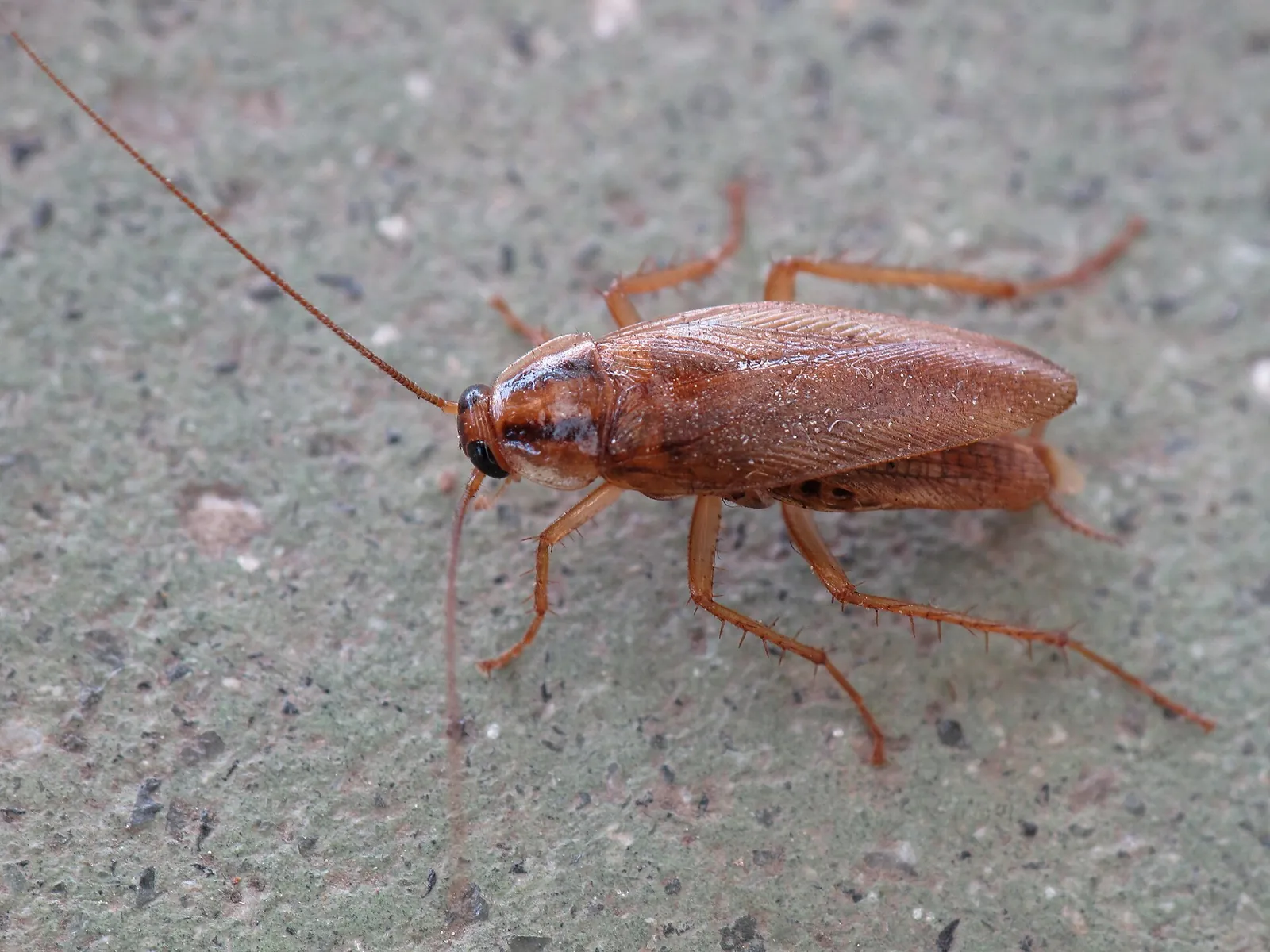
Look for two dark parallel stripes running lengthwise on the shield behind the head. Those stripes are the giveaway. The body is light tan to honey brown, roughly 12 to 16 mm as an adult, and the wings lie flat over the abdomen. Adults have wings but essentially never fly in Indian homes; they run.
Nymphs are much darker, almost black with a pale stripe down the back, and they are wingless. People frequently mistake nymphs for a separate species or for beetles. If you find a mix of tiny dark ones and tan striped ones in the same cupboard, that is one population at different ages, and it means breeding is happening on the premises.
| Feature | German cockroach | American cockroach |
|---|---|---|
| Adult size | 12-16 mm | 35-45 mm |
| Marking | Two dark stripes on the pronotum | Pale yellowish figure-of-eight pattern |
| Where it hides | Warm dry voids in kitchen furniture, appliances | Drains, sewer chambers, manholes, shafts |
| How it arrived | Carried in with cartons, bags, second-hand appliances | Walked in through the plumbing |
| Flying | Almost never | Glides down from height |
| Right first move | Gel bait in many small dots | Seal drain entry and treat the line |
The breeding maths that makes this species so persistent
A female produces an egg case called an ootheca holding 30 to 40 eggs. Unlike other roaches she carries that case attached to her abdomen until roughly a day before hatching, which protects it from almost every spray you could apply. She will produce four to eight such cases in her life.
At the temperature of a working Indian kitchen — 28 to 32 degrees — egg to adult takes about 50 to 60 days. Adults live around 100 to 200 days. Put those figures together and one pregnant female smuggled in inside a carton of provisions can become several hundred insects in a single quarter.
What this species actually damages
German cockroaches do not chew furniture and they do not damage the building. The harm is contamination and health. They walk over drain traps and rubbish and then over your utensils, carrying Salmonella, Shigella and E. coli on their legs and in their droppings.
The under-recognised damage is respiratory. Their shed skins and faecal particles are a well-documented indoor allergen and a recognised asthma trigger in children, especially in tightly packed housing where the same air recirculates. In food businesses the damage is commercial — a live sighting during an FSSAI inspection can shut a kitchen for the day.
- Smearing on packaging and utensil surfaces, and the characteristic musty odour when numbers are high.
- Black specks like ground pepper along cupboard edges and hinge lines — that is faecal deposit, and it is also a chemical trail that attracts more roaches.
- Damage to electronics: they nest inside microwave and induction hob housings and their droppings corrode contacts.
- Allergen load in dust, measurable months after the insects themselves are gone.
Why spraying makes this infestation worse
Pyrethroid sprays are repellent. When you fog a kitchen, the population does not sit in the treated cabinet and die — it disperses into wall voids, behind the false ceiling, into the neighbour's adjoining cupboard. You go from one concentrated cluster you could have baited to five scattered ones you cannot find.
There is a second problem. Indian populations of this species have shown broad resistance to older pyrethroids from decades of over-the-counter aerosol use. A can of household spray now often kills the individuals it directly wets and nothing else.
Gel baiting done the way that works
Gel bait works because roaches feed, return to the harbourage, and then die there — and other roaches eat the corpse and the droppings. That secondary transfer reaches insects you never see. Fipronil at 0.05 percent and imidacloprid at 2.15 percent are the two common actives in India.
- Place many small dots the size of a grain of rice, not a few large blobs. Thirty to forty dots in a normal kitchen is a sensible target.
- Put them at the back inner corners of cabinets, along hinge lines, under the sink, behind the fridge compressor grille and beside the microwave vent.
- Stop all spraying in that room. Residual spray on a surface repels roaches away from a bait dot placed near it.
- Do not clean cabinets with strong disinfectant during the treatment window. It kills the odour trail the bait relies on.
- Recheck at day 14. Dots that have been eaten down get refreshed; untouched dots get moved, because the placement was wrong, not the bait.
Expect a visible crash in seven to ten days and near-elimination at four to six weeks in a home. A restaurant kitchen with continuous food and heat usually needs three rounds over eight weeks.
When you can skip treatment entirely
One roach seen once in a flat with no other evidence is often a hitchhiker that arrived that day in a delivery bag and has nowhere to breed. Do not book a treatment on that alone. Set a sticky monitor under the sink and behind the fridge, leave it a week, and look. Empty monitors mean no established population.
Equally, a treatment that only covers your kitchen will disappoint if the shop or flat sharing a wall with you is infested. In a row of shops or a chawl kitchen block, the honest advice is to treat the adjoining units together or accept repeated reinfestation.
Keeping them from coming back in
Because this species arrives by transport rather than by walking, the prevention is a receiving habit rather than a sealing job. Unpack grocery cartons at the door and put the cardboard straight out — corrugated board is a preferred harbourage and egg cases travel in the flutes.
- Refuse second-hand kitchen appliances unless you can open and inspect the housing first.
- Keep the area behind and under the fridge dry and dust-free; condensate drip is a reliable water source for them.
- Fit door sweeps on shop shutters where the gap runs into a shared corridor.
- Use a sticky monitor as a permanent early-warning tool in any commercial kitchen; it costs almost nothing and catches the problem at week one instead of month three.